The Ultimate Beginner’s Guide: How to Read Sheet Music Basics
Learning to read sheet music is often compared to learning a foreign language. At first glance, a page of music looks like an intimidating labyrinth of black dots, lines, swirls, and foreign terms. However, just like learning to read English, Spanish, or Mandarin, the process relies on breaking down a highly logical system of symbols into foundational building blocks. Once you understand what these symbols represent, the mystery evaporates, and a lifetime of musical literacy opens up to you. Whether your goal is to sit down at a piano, pick up a violin, or simply understand the architecture behind your favorite songs, mastering the basics of reading music is one of the most rewarding intellectual and creative investments you can make.
The benefits of reading music extend far beyond the physical act of playing an instrument. Sheet music is a universal preservation system; it allows a composer from eighteenth-century Vienna to communicate precise emotional and technical instructions to a musician in twenty-first-century Tokyo. When you learn to read music, you are not just memorizing rules; you are training your brain to translate visual stimuli into auditory art and physical coordination simultaneously. This comprehensive, deep-dive guide is designed to take you from absolute scratch—assuming zero prior musical knowledge—and walk you through the essential mechanics required to confidently read, interpret, and perform standard musical notation.
1. The Architectural Framework: Understanding the Staff, Lines, and Spaces
Before you can decode a single note, you must understand the canvas upon which all western music is drawn: the staff. The musical staff is a rigid, highly organized grid composed of exactly five horizontal lines and four spaces that sit between them. This structure serves as a vertical ladder for sound. Every single line and space on the staff represents a distinct, specific musical pitch. The fundamental rule of the staff is incredibly intuitive: the higher up a note is placed on this ladder, the higher its pitch will sound to the human ear; conversely, notes resting near the bottom of the staff represent lower, deeper frequencies.
When reading a staff, it is crucial to always count the lines and spaces from the bottom up. The very bottom line is recognized as Line 1, while the very top line is Line 5. Similarly, the space immediately above Line 1 is Space 1, leading up to Space 4 at the top. On its own, a blank staff is completely anonymous—it shows us relative relationships between high and low notes, but it does not assign specific names or letters to those positions. To give these lines and spaces concrete meaning, we must anchor them using an overarching symbol known as a clef, which serves as the master key to unlocking the exact notes of the musical alphabet.
2. Breaking Down the Alphabet: Pitches and the Musical Scale
Unlike the English alphabet, which forces you to memorize twenty-six distinct letters, the musical alphabet is exceptionally elegant and mercifully brief. It consists of only seven letters: A, B, C, D, E, F, and G. These seven letters represent the consecutive white keys on a piano, and they form the bedrock of all Western musical notation. Once you climb the ladder from A up to G, you do not move on to H; instead, the alphabet cycles right back around to A, starting over at a higher frequency known as an octave. This repeating loop continues indefinitely across the entire range of human hearing.
When these notes are written on the staff, they step sequentially from a line to a space, then to the next line, and then to the next space. For example, if a note on a specific line is an A, the note resting in the space immediately above it will be a B, and the note on the line directly above that will be a C. Because the staff is a literal visual map of this alphabet, musicians rely on spatial memory to instantly recognize notes without having to manually count up from the bottom of the page every time. Over time, your brain stops seeing individual letters and begins recognizing structural patterns, intervals, and steps.
3. The Treble Clef: Navigating the Higher Registers
The most common symbol you will encounter in your musical journey is the Treble Clef, also historically referred to as the G-Clef. Visually characterized by its elegant, looping ornamental swirl, the treble clef is positioned at the far left edge of the staff and designates notes that fall into the higher registers of sound. This is the realm of instruments like the violin, flute, trumpet, and guitar, as well as the right-hand notes played on a piano or the vocal melodies sung by sopranos and altos.
The alternate name, “G-Clef,” provides an immediate clue to its function. If you look closely at the stylized swirl of the treble clef, you will see that its main circular loop wraps directly around the second line from the bottom of the staff. The clef is literally pointing at that line and declaring: “This line is the note G.” Once you have this single anchor point established, you can theoretically calculate every other note on the staff by counting forward or backward through the musical alphabet. To bypass this tedious counting, beginners utilize two incredibly popular, time-tested mnemonic devices to memorize the treble clef layout instantly.
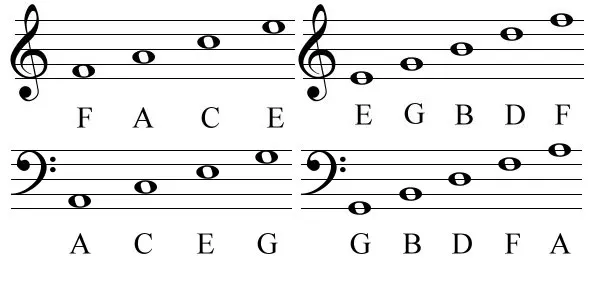
The four spaces of the treble clef are remarkably easy to memorize because, when read from bottom to top, they explicitly spell out the word FACE. The first space is F, the second is A, the third is C, and the fourth is E. For the five lines, musicians rely on the classic acronym: Every Good Boy Does Fine. Line 1 stands for E, Line 2 is G (where the clef loops), Line 3 is B, Line 4 is D, and Line 5 is F. By keeping these two memory aids in your toolkit, you can quickly identify any note written in the treble register within fractions of a second.
4. The Bass Clef: Mastering the Lower Registers
When music dives into the deeper, resonant frequencies of the acoustic spectrum, the treble clef steps aside to make room for the Bass Clef, also known as the F-Clef. This symbol is instantly recognizable by its heavy, curved crescent shape followed by two distinct dots positioned stacked on top of each other. The bass clef dictates the lower registers of music, providing the roadmap for instruments like the cello, double bass, bassoon, trombone, tuba, and the left-hand accompaniment patterns on a piano.
Just as the treble clef acts as an anchor for G, the bass clef acts as a definitive anchor for the note F. The two dots of the bass clef are intentionally positioned to perfectly sandwich the second line from the top of the staff. This specific line is officially designated as F. Because the bass clef shifts the entire orientation of the staff downward, you cannot use the “FACE” or “Every Good Boy” rules here. Attempting to do so is the number one mistake beginners make when transitioning between hands or instruments, resulting in completely incorrect readings.
To successfully navigate the bass clef, you must adopt a completely fresh set of mnemonic devices designed specifically for its unique layout. For the five lines of the bass clef, from bottom to top, use the phrase: Good Burritos Don’t Fall Apart (G, B, D, F, A). For the four spaces embedded within the bass staff, memorize the sentence: All Cows Eat Grass (A, C, E, G). While shifting between these two mental maps can feel clumsy at first, dedicated practice will eventually automate the process, allowing your eyes to adjust to whichever clef is presiding over the staff.
5. Beyond the Grid: Ledger Lines and the Grand Staff
Now that you understand both the treble and bass clefs, you might wonder what happens when a composer wants to write a note that is too high for the treble clef or too low for the bass clef. Human voices and musical instruments regularly exceed the boundaries of a simple five-line staff. To accommodate these extreme pitches without making the page look chaotic, music utilizes temporary miniature lines called ledger lines. Ledger lines act as short, localized extensions of the staff, drawn directly through or beneath individual note heads that live out in the margins of the main grid.
The most famous and foundational example of a ledger line note is Middle C. Middle C acts as the physical and conceptual bridge between the treble and bass registers. If you take a treble staff and look below its bottom line (E), you can draw a single short horizontal dash with a note resting right on it; that note is Middle C. Conversely, if you look at a bass staff and look above its top line (A), that exact same Middle C sits on a ledger line just above the boundary.
When a treble staff and a bass staff are stacked directly on top of one another and joined together by a vertical bracket on the left margin, they form what is known as the Grand Staff. The Grand Staff is the standard formatting blueprint for piano music, harp music, and complex choral arrangements. It provides an expansive, panoramic view of the musical landscape, allowing a player to read high melody lines with their right hand while simultaneously tracking deep basslines with their left hand, tracking both parts across a unified timeline.
6. Anatomy of a Note: Decoding Note Values and Rests
Identifying the pitch of a note only solves half of the musical equation. Knowing which note to play is useless unless you also know how long to hold it. This is where the physical anatomy of a musical note comes into play. A written note is not just a generic circle; it is a highly detailed piece of data composed of three distinct structural components: the note head (the oval body), the stem (the thin vertical line attached to the head), and the flag (the small wavy tail attached to the top or bottom of the stem). The specific combination of these elements dictates the note’s rhythm and duration.
- Whole Note: This note consists solely of an open, hollow note head with absolutely no vertical stem attached to it. It represents the longest basic duration in common notation, receiving a full 4 beats of time.
- Half Note: This note features a hollow note head, but introduces a vertical stem. It cuts the duration of a whole note directly in half, receiving 2 beats of time.
- Quarter Note: This note is characterized by a completely filled-in, solid black note head attached to a vertical stem. It represents the standard pulse of most music, receiving exactly 1 beat of time.
- Eighth Note: This note features a solid black note head, a stem, and a single flag attached to the tip of the stem. It splits a quarter note in half, receiving 1/2 of a beat. When multiple eighth notes appear next to each other, their flags are often connected by a thick horizontal bar called a beam to make the music easier to read.
Crucially, music is defined by its moments of silence just as much as its moments of sound. For every single note value in existence, there is an equivalent rest symbol that dictates a precise duration of absolute silence. A whole rest looks like a small dark block hanging down from the fourth line of the staff, commanding 4 beats of silence. A half rest looks nearly identical but sits resting on top of the third line like a top hat, demanding 2 beats of silence. A quarter rest is a stylized, squiggly symbol representing 1 beat of silence, while an eighth rest looks like a slanted line with a single small bulb, standing for a half-beat of rest.
7. Measures, Bar Lines, and Time Signatures: Navigating Musical Time
If notes were simply written in a continuous, uninterrupted stream across the page, tracking your place would be nearly impossible. To create a clean sense of organization, sheet music is divided into short, manageable blocks of time called measures (or bars). These measures are separated from one another by thin, vertical dividers known as bar lines. The bar lines do not change how the music sounds or alter the rhythm; they function strictly as visual punctuation marks, helping your eyes scan the page rhythmically without getting lost in a sea of identical notes.
The internal boundaries of these measures are dictated by the time signature, which appears as two numbers stacked vertically right after the clef at the very beginning of a piece. The time signature is the mathematical rulebook for the song’s pulse.
- The Top Number: Specifies exactly how many beats must be contained within every single measure.
- The Bottom Number: Indicates what specific note value serves as the core unit of a single beat.
The most ubiquitous time signature in western music is 4/4 time, which is so common that it is often replaced by a stylized letter “C” standing for “Common Time.” In a 4/4 time signature, the top number tells us that each measure must hold precisely four beats, while the bottom number (4) dictates that a quarter note receives exactly one beat. Therefore, a single measure of 4/4 time could be filled by one whole note ($1 \times 4 = 4$), two half notes ($2 \times 2 = 4$), four quarter notes ($4 \times 1 = 4$), or eight eighth notes ($8 \times 0.5 = 4$). No matter what combination of notes and rests a composer chooses, the mathematical total inside that measure must always equal exactly four beats before the bar line seals it shut.
8. Modifying the Pitch: Accidentals and Key Signatures
Once you have mastered the basic white keys of the musical alphabet, you are ready to explore the black keys, which represent the micro-tones hidden between our standard letters. To access these tones, sheet music employs symbols called accidentals: sharps, flats, and naturals. Accidentals alter the pitch of a note by a half-step (the smallest distance between two adjacent keys on a piano).
- The Sharp ($\sharp$): Looks similar to a hashtag symbol. When placed directly to the left of a note head, it instructs the musician to raise the pitch by one half-step, making it sound slightly higher.
- The Flat ($\flat$): Looks like a stylized, lowercase letter “b”. When placed next to a note head, it commands the player to lower the pitch by one half-step, making it sound deeper.
- The Natural ($\natural$): Acts as an immediate cancellation safety valve. If a note was previously made sharp or flat earlier in a measure, placing a natural sign next to it instantly resets the note back to its original, unaltered pitch.
If a song uses certain sharps or flats repeatedly throughout the entire piece, writing an accidental next to every single note would quickly clutter the page and make it unreadable. To solve this problem, composers group these recurring sharps or flats together at the very beginning of the staff in an area called the key signature. The key signature sits safely sandwiched between the clef and the time signature. If you see a sharp symbol sitting on the F line in the key signature, that is a global rule stating: “Every single F you play in this entire song must automatically be played as an F-sharp, unless a natural sign explicitly overrides it.” Key signatures instantly establish the tonal center, or “key,” of the piece, allowing the rest of the sheet music to remain clean, elegant, and streamlined.
Frequently Asked Questions (FAQs)
How long does it typically take to learn to read sheet music basics?
Understanding the conceptual basics of sheet music—such as memorizing the clefs, the lines, the spaces, and basic note durations—can easily be accomplished in a single afternoon. However, building fluent sight-reading skills (the ability to look at a new piece of music and play it fluidly in real-time) requires consistent daily practice over several months or years, much like building reading speed in a new written language.
Why does music notation use both a treble clef and a bass clef?
Music uses multiple clefs to avoid forcing musicians to read an excessive number of ledger lines. If a piano piece written for deep bass notes was forced to fit onto a standard treble clef staff, the notes would sit dozens of ledger lines below the grid, making the music incredibly difficult to scan quickly. Splitting the register across treble and bass clefs keeps the notes neatly centered inside the five-line staff.
What is the difference between a note and a rest?
A note represents a period of active sound, indicating both a specific pitch and a duration for how long that sound should be held. A rest represents a period of intentional silence, indicating a precise duration of time where the musician must not play or sing. Both notes and rests share identical rhythmic values (whole, half, quarter, eighth, etc.).
How do I know which hand plays which part when reading piano sheet music?
In standard piano sheet music formatted on a Grand Staff, the upper staff (which usually features a treble clef) is played by the right hand, while the lower staff (which usually features a bass clef) is played by the left hand. However, always follow the natural flow of the notes; occasionally, a composer will use explicit text markings or cross-staff indicators to signal exceptions.
What does a dot next to a note head mean?
A dot placed directly to the right side of a note head is called a “rhythmic dot.” It increases the original duration of that note by exactly half of its original value. For example, a standard half note gets 2 beats of time. If you add a dot to it, you take half of its value (1 beat) and add it to the original total, creating a dotted half note that lasts for exactly 3 beats ($2 + 1 = 3$).
Are sheet music symbols the same for all instruments?
Yes, the foundational language of Western sheet music—including the staff, note values, rests, time signatures, and accidentals—is standardized across almost all instruments worldwide. However, certain instruments use unique variations or completely different clefs (like the Alto Clef for violas or guitar tablature) to better accommodate their specific physical layout and pitch ranges.




Post Comment